(Part Four of a Four-Part Series on the Only Three Retirement Outcomes)
In the first article of this series, I described the simple framework behind every retirement outcome. In the second, I explored the painful failure that comes from misalignment. In the third, I described orbit—a successful, balanced retirement where spending and returns find equilibrium.
This final article is about the rarest outcome.
It’s not rare because it requires genius.
It’s rare because it requires restraint.
And patience.
And a willingness to keep going long after “enough” has already arrived.
I call this outcome escape velocity.
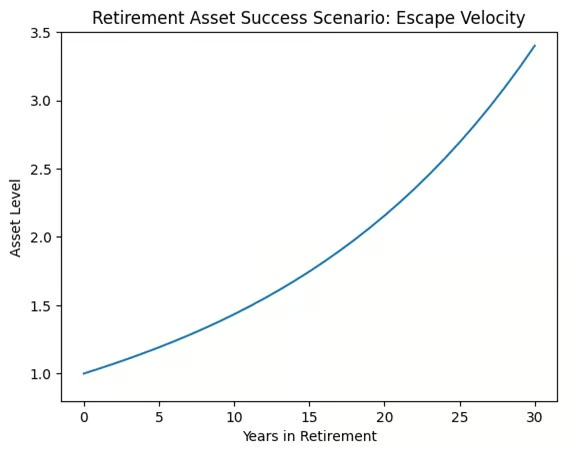
Escape velocity is the point at which a portfolio no longer merely supports life—it transcends the need to be managed defensively at all. It’s where dividend returns alone consistently exceed inflation-adjusted spending, year after year, so that unused returns are reinvested and future returns accelerate. The portfolio never meaningfully declines. In fact, it grows.
This is what I mean by real wealth.
Real wealth is not a number on a statement. It’s not the ability to buy more things. Real wealth is money that doesn’t run out. It’s a river that widens and deepens as it flows—meeting present needs easily while continuing forward long after the person who started it is gone.
Like every outcome in this series, escape velocity is a function of the same three variables: saving rate, equity ownership, and withdrawal behavior. What changes here is how intentionally—and how consistently—they are aligned.
This outcome begins with an unusually strong commitment during the accumulation years. People who reach escape velocity tend to save at a higher rate than average, often much higher. Not because they are fearful or ascetic, but because they are clear. They understand early that spending every dollar of income creates dependence, while saving creates sovereignty. They make a choice to save.
And then they allow time to do its work.
But saving alone doesn’t create escape velocity.
The defining feature of this outcome is a deep, sustained commitment to owning the great companies of the United States and the world. Not trading them. Not guessing which sector will win next. Owning them broadly, patiently, and unapologetically.
It’s a one-and-done choice. I made the decision one time—to own broadly diversified equities with every investible dollar—and then I never had to make it again.
This ownership represents participation in productivity and progress—in human ingenuity itself. We own companies that innovate, adapt, raise prices as costs rise, grow cash flows, and increase dividends over long periods of time. This is why equities matter so much here. They are not a growth accessory. They are the engine.
For many investors who move toward escape velocity, retirement income begins earlier than expected. In the early years, dividends from equity ownership often cover a meaningful portion of living expenses. Not all of it—but enough to change the psychology of retirement.
Instead of selling assets to fund life, life is increasingly funded by the dividends of ownership.
Over the next five to seven years, something remarkable tends to happen. Portfolio growth continues. Dividends rise. Historically, dividend growth has exceeded inflation by two to three times over long periods—not every year, but over time. As those dividend streams accrete, they begin to cover more and more of the retiree’s expenses.
Eventually, dividends alone cover all spending needs.
At that point, the portfolio’s volatility ceases to matter entirely. Withdrawals fall dramatically as a percentage of portfolio value. Market volatility loses its power. Spending no longer depends on selling shares at all.
And then, quietly, the portfolio begins to grow faster.
Five to seven years later, dividend income exceeds spending needs. Principal is never again required. A growing percentage of that regular dividend income is reinvested back into the portfolio itself. The corpus grows faster. Future dividends grow faster. As the percentage of the dividends required for spending becomes smaller and smaller each year, portfolio growth accelerates.
This is escape velocity.
At this point, the central question of retirement planning changes completely. It is no longer, “Will I be okay?”
It becomes, “What do I want this wealth to do?”
This is where generosity becomes effortless rather than aspirational. Giving doesn’t threaten security—it expresses it. Support for family is possible without anxiety. Philanthropy becomes structural rather than episodic. Causes and communities benefit not just from gifts, but from sustained partnership.
And legacy shifts from a vague hope to a tangible, inflation-beating reality.
I should say clearly: this third outcome has been my goal for as long as I can remember.
I grew up with very little. I remember my parents borrowing money from Auntie Della so they could buy their first home. I remember struggling to pay for tuition, the constant math of scarcity, the used soccer cleats, the worn-out skis, the coupons clipped for every grocery trip. None of this is shameful. I lived it. It made me who I am.
But even as a kid, I knew I wanted something different for the generations that came after me.
Before I was ten years old, my father put an idea into my head that never left: the idea of a family bank. A pool of resources that could support future generations—not indulgently, but meaningfully. Help with first homes. Education without debt. Access to healthcare without fear of breaking the bank. Opportunity without panic.
That idea stayed with me through every stage of my life.
And today, after decades of study, practice, and lived experience, I see the clarity—and the inevitability—of the decisions that make this outcome possible.
They are not mysterious.
Save a higher percentage of income—at least 15% from your very first paycheck, and more if you can.
Invest all excess funds into the great companies of the U.S. and the world.
Manage and limit spending in retirement to less than 4%, or… roughly half of the long-term expected return of your portfolio.
That’s it.
No prediction.
No market timing.
No cleverness required.
Now you know exactly which choices lead to this outcome. The only issue left is the hardest one: closing the gap between knowing and doing.
If you knew absolutely that this outcome were inevitable—if you could see, clearly, where these decisions lead—would you want to make the trade-offs required? Could you live with less consumption and more volatility today in exchange for freedom, generosity, and legacy tomorrow?
The problem is always one of trade-offs. Either choice is fine. People retire successfully every day with “Orbit” (from last week’s article).
There is NO right answer. But these questions deserve honest reflection.
Running out of money before you run out of life, finding balance in orbit, and escape velocity—these are the only three retirement outcomes.